It consumes valuable employee time
Teams spend hours searching websites, copying information, checking changes, and maintaining spreadsheets.

Extract web data automatically. Turn scattered website information into structured business data.
DataCrops Web Data Extraction Software helps businesses collect information from public websites, structure and transform the data, and deliver it into the formats and systems they already use. From product catalogs and competitor information to market trends and customer feedback, DataCrops helps turn web data into a usable business asset.
Trust statement:
DataCrops describes its platform as a scalable, AI powered web data extraction solution and offers Data as a Service for businesses that want managed data collection rather than maintaining extraction infrastructure themselves.
The web contains high amounts of information, but collecting that information manually is difficult to scale.
Product pages change. Competitor catalogs expand. Marketplaces update listings. Prices and availability move. New information appears every day.
The challenge isn't simply finding data.
The challenge is collecting the right data consistently, structuring it correctly, and making it available when your business needs it.
Our web data extraction software can collect information from websites and other web sources, transform raw information into structured datasets, and deliver the resulting data through formats and integrations suited to your workflow.
For businesses that need ongoing data rather than a one time scrape, this creates a repeatable data pipeline instead of another manual research task.
Web data extraction software is technology that automatically collects information from websites and converts it into structured, useful data.
Instead of manually copying information from hundreds or thousands of pages, businesses can define the data they need and automate its collection.
The important distinction is that modern web data extraction is not just about collecting HTML.
A useful extraction workflow also needs to identify relevant fields, normalize information, remove unwanted data, transform formats, and deliver structured datasets for analysis or operational use.
Manual web research may work for a small number of pages. It becomes a very different problem when your team needs to monitor thousands of products, hundreds of competitors, multiple marketplaces, or frequently changing websites. Manual data collection creates five common problems:
Teams spend hours searching websites, copying information, checking changes, and maintaining spreadsheets.
A spreadsheet can be accurate when it is created and outdated shortly afterward.
Adding more websites usually means adding more people, processes, or technical resources.
Page layouts, URLs, content structures, and JavaScript behavior can change over time.
Information collected manually often sits in spreadsheets instead of flowing directly into analytics, BI, ERP, CRM, pricing, or internal systems.
Automated web data extraction addresses these challenges by turning repetitive collection into an ongoing, technology driven process.
The best way to handle web data extraction depends on your data volume, source complexity, refresh frequency, and downstream requirements.
For businesses with recurring data requirements, the strongest approach is generally a managed and automated pipeline:
DataCrops is designed around this broader workflow rather than treating scraping as an isolated technical task.
The platform supports automated crawling, structured extraction, data transformation, aggregation, and delivery through formats and integrations including APIs, Excel, CSV, XML, JSON, FTP, and database Integration.
Replace manual copy and paste work with automated web data extraction workflows, saving time and improving data collection efficiency.
Your team can spend less time collecting information and more time analyzing what that information means.
Extract structured data from 15,000+ websites, marketplaces, and portals, including JavaScript rendered and paginated sources.
Scale your data collection across large volumes of pages and sources without relying on manual data gathering.
Clean, normalize, enrich, aggregate, and transform raw web data into structured, business ready datasets.
DataCrops makes the extracted information easier to analyze, compare, integrate, and use for business decision making.
Extract data from websites using JavaScript, dynamic content, pagination, and interactive interfaces.
DataCrops is designed to handle modern, complex web environments, not just simple static HTML pages.
Automate recurring data collection to maintain fresh and up to date web data for pricing, products, competitors, and market intelligence.
Regular data updates help teams track market changes, identify new trends, and make decisions using more current information.
Deliver extracted data through API, Excel, CSV, XML, JSON, FTP, or database synchronization, depending on your requirements.
Connect this data with your existing applications, databases, analytics tools, and business workflows for seamless access and processing.
Deliver extracted data through API, Excel, CSV, XML, JSON, FTP, or database synchronization, depending on your requirements.
Connect this data with your existing applications, databases, analytics tools, and business workflows for seamless access and processing.
AI driven, self healing crawlers are designed to adapt to changing website structures and help minimize extraction errors.
DataCrops reduces the need for frequent manual adjustments, making web data extraction workflows easier to maintain over time.
Collect structured information from websites, marketplaces, portals, and multiple sources through automated crawling workflows.
Scale data collection without scaling manual research at the same rate.
Websites change frequently. DataCrops uses AI driven crawler capabilities designed to adapt to changes in website structures.
Reduce disruption caused by changing page layouts and extraction logic.
Handle websites where important information is rendered dynamically through JavaScript and other modern web technologies.
Access data that traditional static scraping approaches may struggle to capture.
Clean, normalize, enrich, correlate, and transform extracted information into a consistent structure.
Spend less time cleaning raw datasets before analysis.
Combine fragmented information from multiple websites and sources into a unified dataset.
Create a more complete view of markets, products, competitors, or customers.
Support workflows where data needs to be refreshed regularly and delivered to business systems.
Keep operational and analytical datasets closer to current market conditions.
Get extracted data in JSON, XML, CSV, Excel, API, FTP, or database formats to fit your workflow.
Fit extracted data into the systems your teams already use.
DataCrops describes capabilities including role based access, audit logs, encrypted pipelines, and secure data workflows.
Give IT and business stakeholders greater control over how extraction workflows and data are managed.
Identify:
For example, an eCommerce company might require product name, SKU, price, availability, rating, review count, and product URL.
The extraction process is configured around your target websites and required fields.
This is where source specific structures, dynamic content, pagination, and other collection requirements are considered.
Automated crawlers collect the required information from the defined sources.
Instead of manually opening pages and copying information, the workflow handles repetitive collection automatically.
Raw information is cleaned, normalized, structured, and transformed into the required schema.
This makes the dataset easier to compare, analyze, store, and integrate.
Receive the resulting dataset through the delivery method appropriate to your workflow.
That can include files, APIs, FTP, databases, or other custom integrations.
Web data extraction can support a wide range of business datasets.
Extract:
Collect competitor:
Monitor marketplace:
Extract publicly available:
Collect information that helps teams analyze:
Retailers can automate product and competitor data collection across multiple websites and marketplaces.
Use extracted data for:
Marketplaces need visibility across large and constantly changing product ecosystems.
Web data extraction can help marketplace teams understand:
Direct to consumer brands can use web data to understand their category and competitive environment without manually researching every major sales channel.
Potential applications include:
Replace manual research with repeatable, structured datasets collected from multiple online sources.
Use for Teams:
| Capability | Manual Collection | Automated Extraction |
|---|---|---|
| Data collection | Human driven | Automated |
| Scale | Limited | Designed for larger volumes |
| Refresh frequency | Usually inconsistent | Scheduled or recurring |
| Data consistency | Depends on the researcher | Standardized workflows |
| Dynamic websites | Difficult to manage manually | Can be supported through specialized extraction |
| Data transformation | Spreadsheet/manual work | Automated transformation |
| Multiple sources | Time consuming | Multi source aggregation |
| Integration | Usually manual | API/file/database delivery |
| Maintenance | Requires ongoing human effort | Managed automation |
| Business use | Research snapshots | Repeatable data pipelines |
The key difference is not simply speed. It is repeatability.
Automated web data extraction turns data collection from a recurring manual task into an operational process.
Not every data requirement needs an enterprise data extraction platform. For recurring business data needs.
DataCrops is designed for organizations that need:
Large and recurring extraction workflows.
Data structures built around business requirements.
Less dependence on manual collection.
Clean and normalized data rather than raw page content.
Data delivered into business systems and workflows.
A solution designed around ongoing extraction rather than a one time scrape.
Web data that can support pricing, product, competitive, market, and business intelligence workflows.
DataCrops combines web crawling, extraction, transformation, aggregation, and delivery as part of a broader data workflow.
For organizations that need more than raw scraped information, DataCrops 5.0 extends the workflow into data processing and intelligence.
The platform is positioned around three connected capabilities:
Automatically collect information from multiple web sources.
Clean, normalize, and structure information into usable datasets.
Connect the resulting information with analytics and business workflows to support better decisions.
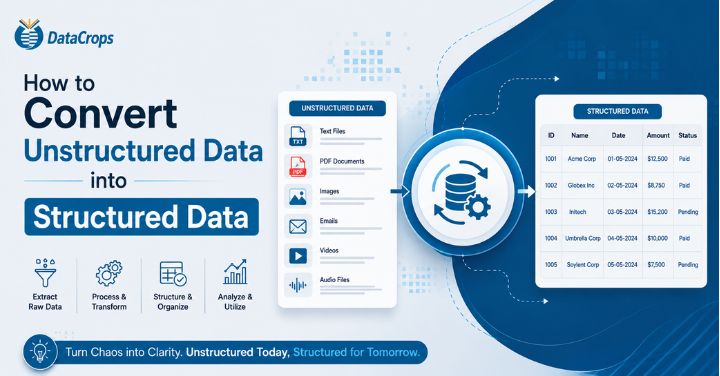
DataCrops describes DataCrops 5.0 as an AI powered web data extraction and data processing platform designed to transform unstructured data into actionable business information.
A scraper gives you collected information. A business data pipeline gives you something more useful:
For example:
The goal is not to collect the largest amount of data. The goal is to deliver the right data in the right structure at the right time.
Websites are not static databases. They change their layouts, URLs, navigation structures, content presentation, and technical behavior. That is why reliable web data extraction requires more than a basic page parser.
DataCrops' current solution highlights support for JavaScript rendered pages, pagination, automated crawling, AI driven self healing crawlers, data transformation, aggregation, and recurring delivery.
This approach is particularly valuable for businesses whose datasets need to remain operational as their target websites evolve.
Extracted data becomes more valuable when it reaches the team or system that needs it.
DataCrops specifically identifies APIs, Excel, CSV, and custom data formats as supported integration options.
Web data extraction can be used legally, but legality depends on what data is collected, how it is collected, and the applicable laws and website rules.
Businesses should consider:
Public availability does not automatically mean every type of data can be collected or used without restrictions. DataCrops' own product guidance recommends collecting publicly available information responsibly and complying with applicable laws, website terms, and privacy requirements.
Choosing web data extraction software is not only a technical decision. For business critical data, organizations also need to consider the provider behind the technology. DataCrops states that it has more than 18 years of experience in IT and data automation and supports organizations with scalable data extraction and intelligence solutions.
DataCrops combines data engineering and domain expertise to support customized extraction requirements.
The platform is designed for large scale, recurring web data collection.
Extraction workflows include data validation and transformation processes intended to produce usable datasets.
Data can be delivered through multiple formats and integration methods.
DataCrops provides support throughout setup and ongoing data delivery.
Web data extraction software is a strong fit when:
If your requirement is occasional and small, a basic scraping tool may be enough.
If web data is becoming part of your business infrastructure, a managed extraction platform is worth evaluating.
Web data extraction software automatically collects information from websites and converts it into structured formats such as CSV, Excel, JSON, XML, APIs, or databases. Businesses use it to collect product, competitor, marketplace, market, and other publicly available web data.
The best web data extraction software depends on your sources, data volume, required fields, refresh frequency, technical requirements, and integration needs. For enterprise use, look for scalable crawling, dynamic site support, data transformation, automation, quality controls, and flexible delivery options.
Web scraping generally refers to collecting information from websites. Web data extraction includes the broader process of collecting, structuring, cleaning, transforming, and delivering that information so it can be used by business systems.
Yes. DataCrops states that its web data extraction solution supports dynamic websites, including JavaScript rendered content, pagination, and other modern web structures.
Yes. Automated web data extraction can collect product information from multiple websites and sources and consolidate it into a standardized dataset. DataCrops supports multi source data aggregation and structured product data extraction workflows.
Yes. Automated web data extraction can run recurring crawling and extraction workflows without requiring teams to manually visit and copy information from individual pages.
Depending on the project, DataCrops supports formats and delivery methods including JSON, XML, CSV, Excel, FTP, APIs, and database synchronization.
Yes. Extracted data can be delivered through APIs, databases, files, or custom integrations so it can be connected to downstream business systems. DataCrops specifically identifies ERP, CRM, BI, and other workflow integrations as use cases.
Automation can improve consistency by applying the same extraction, validation, cleaning, and transformation rules repeatedly. However, data quality ultimately depends on the source, extraction configuration, validation process, and monitoring of the workflow.
Modern extraction platforms can be designed to adapt to website changes. DataCrops describes its AI driven self healing crawler capabilities as being designed to respond to changes in website structures.
Pricing depends on factors such as the number of sources, data volume, fields, refresh frequency, complexity, transformations, integrations, and support requirements. A customized demo is the best way to determine the appropriate implementation and commercial model.
Tell us what data you need, where it comes from, and how you want it delivered.
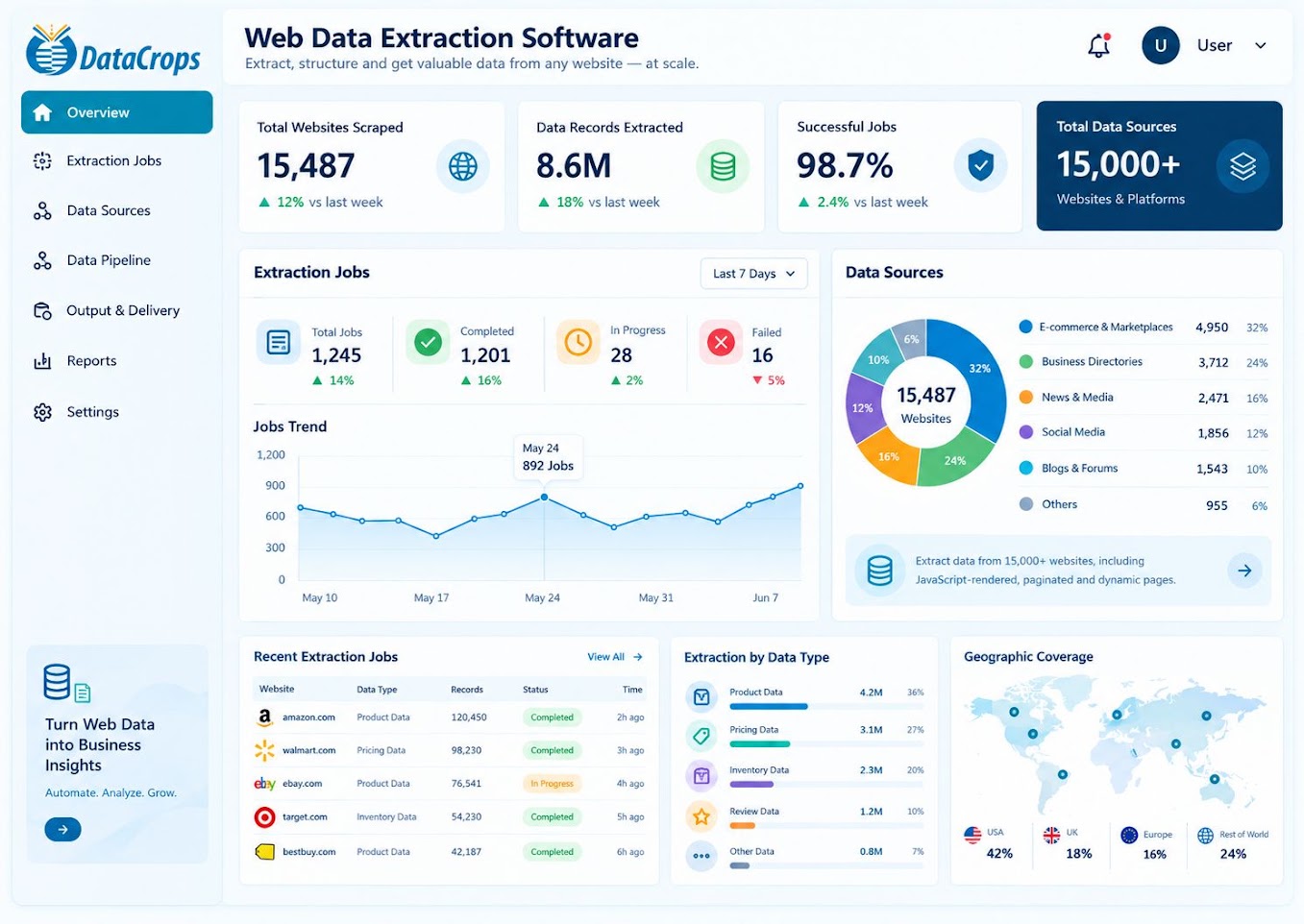
DataCrops is a scalable software platform that intelligently extracts information from multiple websites and complex data sources using a robust self-enhanced technology. It extracts, transforms, and loads it. ensuring the delivery of right information at right time and in right format.