Too much repetitive work
Teams spend hours searching competitor websites and maintaining spreadsheets.

Compare competitor prices, identify pricing gaps, and make faster pricing decisions with automated market intelligence.
DataCrops Price Comparison Software automatically collects and compares product prices across competitor websites and ecommerce marketplaces. Use the data to monitor pricing, identify opportunities, track promotions, and make informed pricing decisions.
Trust statement:
DataCrops currently positions its ecommerce price comparison solution for online retailers, brands, marketplaces, pricing teams, category managers, and revenue strategists.
Pricing teams need market visibility.
But competitor pricing is constantly changing.
A competitor can launch a promotion in the morning, adjust a product price in the afternoon, and change availability later the same day.
If your team relies on spreadsheets, browser tabs, or periodic manual checks, important pricing movements can easily be missed.
DataCrops automates the collection and comparison of pricing information so your team can spend less time gathering data and more time deciding what to do with it.
The objective isn't simply to collect more prices.
It's to understand your position in the market and act on the information.
Price comparison software is a technology platform that automatically collects, matches, and compares product prices from multiple online sources.
Businesses use it to understand how their prices compare with competitors, identify market pricing gaps, analyze promotions, and support pricing decisions.
Unlike a consumer price comparison website, which helps shoppers find deals, B2B price comparison software helps businesses understand and manage their competitive pricing position.
That distinction is important when evaluating software for price comparison.
The value is not just seeing two prices side by side.
The value comes from knowing which products are comparable, where the price gap exists, how significant the difference is, and what action your business should consider.
Manual competitor price comparison can appear simple.
The problem starts when you have hundreds or thousands of products.
Teams spend hours searching competitor websites and maintaining spreadsheets.
Different people may collect, interpret, and record information differently.
Teams can only manually monitor a limited number of products and competitors.
By the time a report is complete, market prices may have already changed.
The same or similar product can appear under different names, SKUs, descriptions, or configurations.
Manually maintained spreadsheets rarely provide a reliable view of pricing movements over time.
Pricing data may remain isolated from analytics, ecommerce, ERP, or pricing systems.
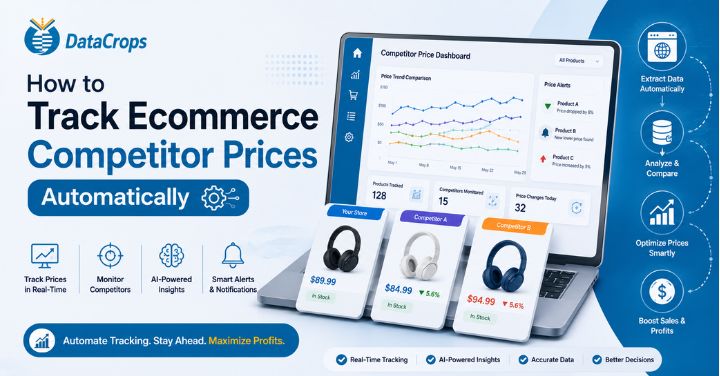
Automated price comparison addresses these limitations by creating a repeatable data collection and analysis workflow.
A modern price comparison platform brings several activities into one workflow.
DataCrops uses web data extraction as the foundation for collecting pricing information from multiple sources. The platform's existing ecommerce price comparison offering also highlights product matching, competitor pricing, promotions, availability, dashboards, alerts, and API integration.
This makes price comparison an ongoing business process rather than an occasional research exercise.
Compare your pricing against relevant competitors and understand whether your products are priced above, below, or around the market.
Make pricing decisions using market context instead of assumptions.
Automate repetitive competitor price collection instead of asking employees to repeatedly browse websites.
Free pricing, sales, and product teams to focus on analysis and strategy.
Discover products where your pricing differs materially from competitors.
Identify opportunities for price adjustments, promotions, or further investigation.
Automated collection can support broader coverage than manual research.
Build a more complete view of your competitive landscape.
Price comparison can include more than the standard product price. Track relevant promotional information, discounts, and other pricing signals.
Understand when competitors are actively changing their market position.
Product matching allows businesses to compare equivalent products rather than simply comparing text strings.
Make more meaningful product to product pricing comparisons.
Dashboards, alerts, reports, and API connections can move pricing information closer to the teams that need it.
Reduce the delay between a market change and a business response.
Instead of producing one off price comparison reports, automate recurring collection and analysis.
Turn competitor pricing into an ongoing source of market intelligence.
Collect competitor pricing information across relevant ecommerce websites and marketplaces.
Maintain broader competitive visibility without relying entirely on manual research.
Match comparable products across different websites, catalogs, and marketplaces. Product names, SKUs, descriptions, attributes, and other product information can vary between sources.
Compare like for like products more effectively.
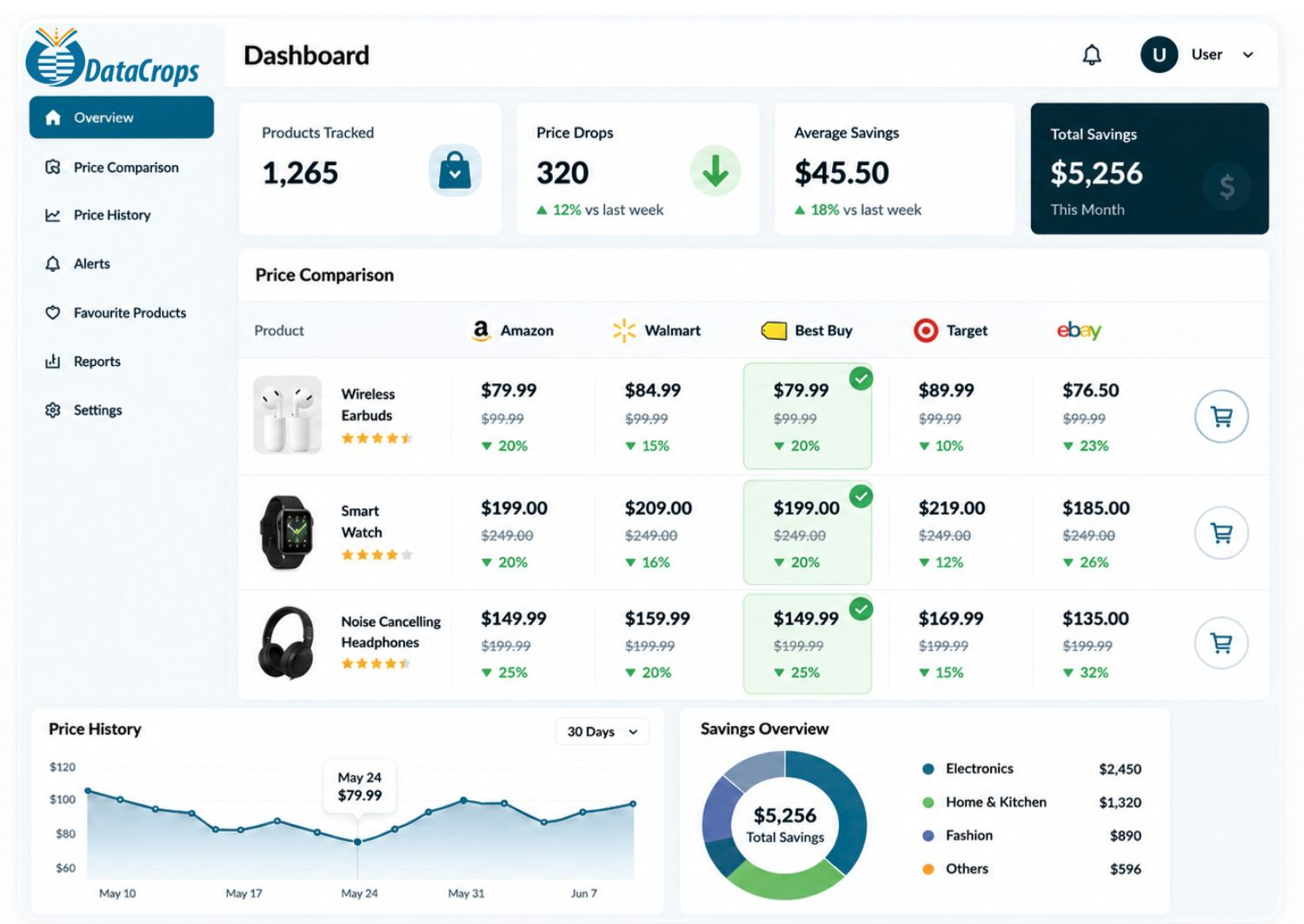
Monitor competitor prices over time and identify changes that could affect your pricing position.
Understand not only the current market price but also how the market is moving.
Analyze differences between your prices and competitor prices.
Identify where your products may be overpriced, underpriced, or competitively positioned.
Track relevant competitor promotions, discounts, special offers, and deal activity to understand pricing changes, promotional strategies, and competitive market movements effectively.
Understand whether apparent price differences are caused by temporary promotions or broader pricing strategies.
Visualize pricing data through structured reports and dashboards. Track minimum, maximum, and average prices while segmenting pricing insights for different teams and business needs.
Give pricing, sales, product, and management teams a shared view of market pricing.
Receive timely notifications when important pricing, competitor, promotional, or market changes occur, helping teams stay informed and respond quickly to significant developments.
Focus attention on meaningful changes instead of continuously checking competitor websites.
Store and analyze historical pricing information to identify trends, recurring patterns, pricing changes, and competitive movements over time for better decisions.
Understand whether a price movement is a one off event or part of a longer trend.
Connect comparison data with existing business systems and workflows. DataCrops' current solution describes API integration with ecommerce and ERP systems.
Bring competitive pricing data closer to your existing operational and analytical processes.
Identify the competitors, websites, marketplaces, categories, brands, and products you want to compare.
Automated data extraction collects relevant pricing and product information from the selected sources.
Products from different sources are mapped to identify equivalent or comparable products.
This step is critical because simply comparing product names can produce misleading results.
The system compares prices and related information to identify:
Pricing information can be presented through dashboards, reports, alerts, APIs, or other configured delivery methods.
The result is a pricing intelligence workflow your teams can use for ongoing decision making.
Product Price comparison software can support a broader view of competitive positioning than price alone.
Compare prices for individual products and SKUs.
Understand which products competitors sell that you don't.
Identify discounts, deals, and promotional pricing.
Monitor whether products are available or out of stock.
Where relevant data is available, compare customer facing product signals alongside pricing.
Analyze pricing and product information across ecommerce marketplaces.
Compare pricing differences across relevant markets or geographic locations.
DataCrops' current ecommerce price comparison solution includes competitor assortment, pricing, promotions, availability, ratings, reviews, product turnover, and market trends as relevant intelligence areas.
Retailers can compare their product pricing against competitors across ecommerce stores and marketplaces.
Common applications:
Direct to consumer brands can monitor how their products are priced across competing sellers and channels.
Common applications:
Marketplaces can analyze pricing and product information across sellers and competing platforms.
Common applications:
Price comparison platforms need reliable product and pricing data from multiple sources to maintain accurate and current comparison datasets.
Common applications:
Pricing and revenue teams can use competitive market data to evaluate pricing positions and make informed decisions about prices and promotions.
Common applications:
Category managers can use competitive pricing data to identify pricing gaps, assortment opportunities, and competitor movements across categories and products.
Common applications:
| Capability | Manual Comparison | Automated Price Comparison |
|---|---|---|
| Data collection | Manual | Automated |
| Number of sources | Limited by team capacity | Designed for broader coverage |
| Update frequency | Periodic | Recurring / configured |
| Product matching | Manual | Automated / rules based |
| Historical analysis | Difficult | Structured data history |
| Alerts | Manual monitoring | Automated alerts |
| Reporting | Spreadsheet based | Dashboards and reports |
| Integration | Often manual | APIs and system integration |
| Scalability | Limited | Built for larger datasets |
| Team effort | High | Lower repetitive workload |
The key difference
Manual comparison produces snapshots. Automated price comparison creates an ongoing pricing intelligence process.
When evaluating a competitor price comparison engine, look beyond the ability to display prices.
A price comparison system becomes more valuable when it connects comparison data with broader pricing intelligence.
This is the difference between simply collecting competitor prices and building a pricing intelligence workflow.
DataCrops' platform describes itself as a scalable software platform that extracts, transforms, and loads information from multiple websites and complex data sources.
One of the biggest challenges in price comparison is not collecting the price.
It is determining whether you're comparing the right product.
A simple text comparison may incorrectly treat two different products as identical.
A strong price comparison workflow therefore needs product level matching and validation before pricing differences are interpreted.
This is why DataCrops positions advanced product matching as a core component of its ecommerce price comparison platform.
A price difference is not automatically a reason to change your price.
The important question isn't simply:
"Should we reduce our price?"
Price comparison software provides the market data.
Your pricing strategy determines what action to take.
That distinction helps businesses avoid turning competitive pricing into a race to the lowest price.
DataCrops' broader platform is built around extracting and transforming information from multiple websites and complex data sources.
The platform supports product matching so pricing comparisons can be based on comparable products rather than simple keyword matches.
DataCrops connects pricing with assortment, promotions, availability, product intelligence, and market trends.
APIs and integration options allow pricing data to become part of broader business workflows.
Pricing requirements vary across industries and organizations. DataCrops can be customized to meet specific competitive price comparison needs when standard tools are not enough.
DataCrops offers pricing intelligence solutions across retail, hotel, flight, tyre, ecommerce, and competitor pricing.
DataCrops has publicly documented a competitive price comparison implementation for a London based travel company.
The client had been manually collecting competitor information, creating additional effort around data collection, validation, analysis, and reporting. DataCrops developed an automated competitive price comparison solution designed around the client's specific requirements.
The case study reports 95% accuracy in web data extraction for that particular implementation.
This should be presented as a case specific result, not as a universal accuracy guarantee for every DataCrops project.
Whether you need to compare:
the implementation can be structured around the data your business actually needs.
The first step is not choosing a plan. It's defining what you need to compare.
Price comparison software automatically collects and compares product prices from multiple websites, retailers, marketplaces, or competitors. Businesses use it to benchmark pricing, identify price gaps, monitor promotions, and support pricing decisions.
Price comparison software focuses on comparing prices across competitors or sources. Price monitoring software focuses more broadly on tracking price changes over time. A business platform can combine both capabilities.
Yes. Automated price comparison software can collect competitor pricing data from configured websites and marketplaces and compare it against your products or other selected sources.
Yes. A suitable platform can collect product information from multiple marketplaces and use product matching to compare equivalent products and their prices.
Product matching ensures that pricing comparisons are made between equivalent or appropriately comparable products. Without matching, differences in product variants, pack sizes, SKUs, or specifications can produce misleading comparisons.
Yes. Depending on the platform and source data, price comparison workflows can track discounts, promotions, deals, and other pricing changes. DataCrops includes promotion and deal tracking in its ecommerce price comparison capabilities.
Yes. Business oriented platforms can provide pricing information through APIs or other integration methods. DataCrops specifically identifies API integration with ecommerce and ERP systems.
The appropriate frequency depends on your industry, product category, competitive intensity, and pricing strategy. Highly dynamic markets may require frequent or near real time comparison, while slower moving categories may only require daily or weekly updates.
Pricing depends on factors such as the number of products, competitors, data sources, refresh frequency, product matching requirements, integrations, reporting, and customization. A demo or consultation is usually the best way to determine the appropriate solution.
See how DataCrops can build a price comparison workflow around your products, competitors, marketplaces, and pricing objectives.

DataCrops is a scalable software platform that intelligently extracts information from multiple websites and complex data sources using a robust self-enhanced technology. It extracts, transforms, and loads it. ensuring the delivery of right information at right time and in right format.