Competitor Price Tracking
Monitor pricing changes across selected competitors and channels.

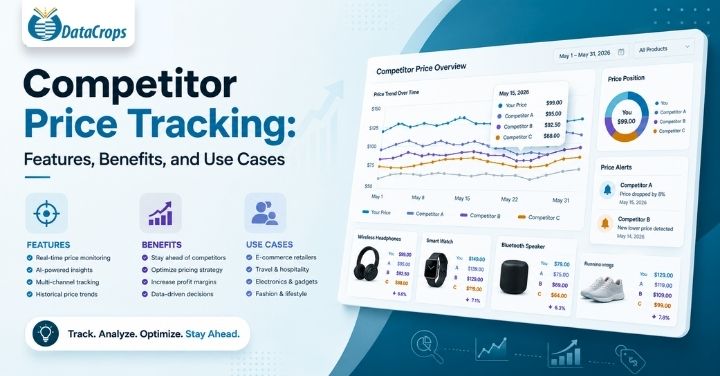
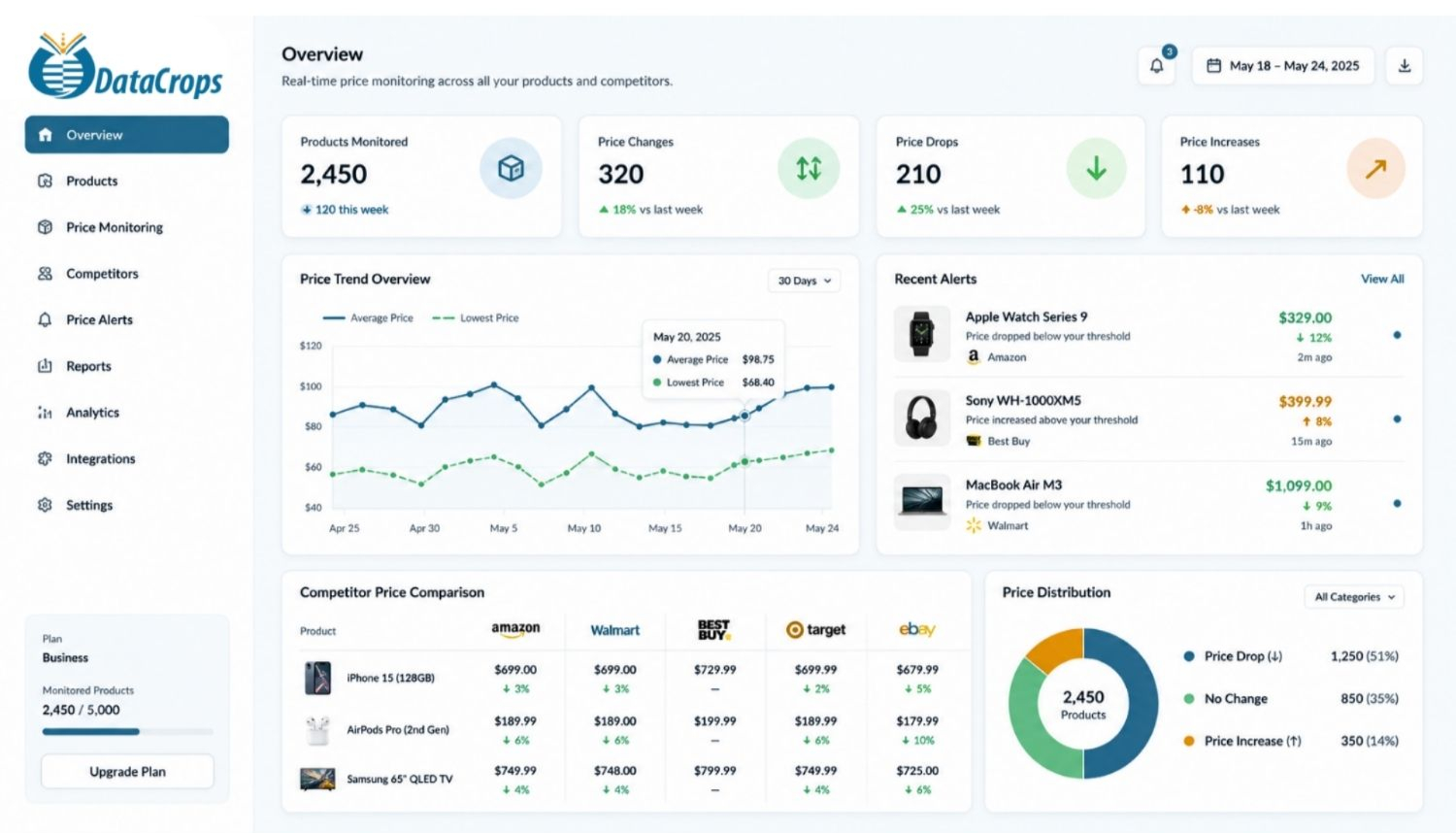
Track competitor prices, promotions, products, and market movements automatically so you can make faster pricing decisions with confidence.
DataCrops Price Monitoring Software helps online retailers, marketplaces, and D2C brands collect, compare, and analyze pricing data across competitor websites and marketplaces. Turn continuously changing market data into actionable pricing intelligence for your business.
Book a DemoTrust statement:
Monitor prices. Understand competition. Price with confidence.
Monitor pricing changes across selected competitors and channels.
Understand how products, prices, promotions, and competitors are changing.
Reduce manual price checks with automated web data extraction.
Designed to support pricing intelligence workflows from focused monitoring to high volume data requirements.
Online prices can change quickly.
A competitor can launch a promotion, reduce a product price, introduce a new product, or change marketplace pricing while your team is still working from yesterday's data.
Manual monitoring makes it difficult to maintain a consistent view of the market.
DataCrops helps replace fragmented manual monitoring with structured, automated pricing intelligence.
Price monitoring software automatically tracks product prices across online stores, competitor websites, marketplaces, and other digital channels so businesses can analyze pricing changes and make informed pricing decisions.
Instead of manually checking hundreds or thousands of product pages, businesses can use automated data collection to monitor selected products and competitors at a defined frequency.
DataCrops combines automated web data extraction, data processing, pricing intelligence, and integration capabilities to turn online pricing information into usable business data.
DataCrops helps businesses automate the collection and analysis of competitive pricing data. Instead of repeatedly visiting competitor websites and maintaining spreadsheets, your team can create a structured price monitoring workflow designed around the products, competitors, markets, and data points that matter to your business.
The result is a clearer view of your competitive pricing environment.
Track pricing information across selected competitor websites and marketplaces without relying entirely on manual checks.
Your team spends less time collecting pricing information and more time interpreting it.
Compare your products against competitor pricing to identify where your prices are above, below, or aligned with the market.
Spot products that may require pricing review before competitive gaps affect performance.
Identify meaningful price movements and competitive changes as they occur within your monitoring workflow.
Give pricing teams timely information for faster decision making.
Monitor competitor promotions, discounts, and deal activity alongside standard pricing.
Understand when competitors are using promotions to influence market demand.
Maintain historical pricing information to understand how competitors and markets change over time.
Move beyond point in time comparisons and identify recurring pricing patterns and trends.
Combine competitor data, product information, market observations, and historical trends to support more informed pricing strategies.
Make pricing decisions based on market evidence rather than assumptions.
Monitor pricing across multiple competitors, products, websites, marketplaces, and markets as your requirements grow.
Create a pricing intelligence infrastructure that can expand with your business.
DataCrops supports automated ETL pipelines and API based connectivity for integrating collected data into broader business and technology environments.
Move pricing data into the systems where your teams already work.
Automatically collect and compare product prices across selected competitor websites and marketplaces.
Retailers and brands that need continuous visibility into competitor pricing.
Analyze current and historical pricing information to understand market movements and support pricing decisions.
Pricing teams looking for more context than a simple price comparison.
Use competitive pricing information as an input into automated repricing workflows and pricing rules.
Businesses operating in highly competitive online marketplaces.
Monitor products, listings, and competitive product information to identify changes and opportunities within your market.
Businesses that need product and pricing information together.
Analyze pricing information through competitor, channel, product, market, or region level views according to the configured solution.
Teams that need structured pricing intelligence for decision making.
Monitor competitor promotions, discounts, and deal activity to understand changes beyond standard list prices.
Retailers and brands competing during promotions, campaigns, and seasonal events.
Build a historical view of pricing changes to identify trends and recurring market behavior.
Pricing analysts and commercial teams conducting trend analysis.
Extract pricing information, transform it into a usable structure, and load it into the required destination.
Businesses with data engineering, analytics, BI, or enterprise integration requirements.
Connect pricing data with existing business applications and data environments through API based workflows where supported.
Organizations that want pricing intelligence to become part of a larger technology ecosystem.
DataCrops states that its pricing intelligence engine uses modular architecture, high volume data extraction, API connections, and ETL pipelines to support scaling pricing monitoring requirements.
Growing retailers, marketplaces, D2C brands, and enterprise teams.
Price monitoring software typically follows a structured data workflow:
Define the competitors, websites, marketplaces, products, categories, or brands you want to monitor.
Automated data extraction gathers relevant pricing and product information from configured sources.
Collected products are mapped to the relevant products or SKUs in your catalog so pricing comparisons are meaningful.
Pricing information can be compared across competitors, channels, products, regions, and historical periods.
Use the resulting intelligence to support pricing reviews, promotions, competitive strategy, repricing workflows, and commercial decisions.
The most scalable approach is to use automated price monitoring software rather than manually checking competitor websites.
DataCrops uses web data extraction and processing capabilities to collect information from online sources and transform it into structured business data.
| Manual Monitoring | Automated Price Monitoring |
|---|---|
| Requires repeated website checks | Automates recurring data collection |
| Difficult to scale | Designed for larger monitoring requirements |
| Spreadsheet heavy workflows | Structured data workflows |
| Delayed visibility | More frequent monitoring possible |
| Higher operational effort | Reduces repetitive work |
| Difficult to maintain historical records | Historical data can be structured and analyzed |
| Limited competitive coverage | Supports broader competitor and product monitoring |
| Prone to inconsistent processes | Standardized monitoring workflows |
Understand how competitors price comparable products and identify meaningful changes.
Monitor pricing across marketplaces where multiple sellers compete for customer attention.
Use competitive pricing information as an input into pricing reviews and commercial decisions.
Track discounts and promotional activity to understand competitive campaigns.
Identify competitive products, assortment changes, and product level opportunities.
Feed competitive market information into dynamic pricing strategies where appropriate.
Use competitor pricing data as an input for automated or rules based repricing workflows.
Combine pricing information with broader market data to understand competitive movements.
Online retailers operate in markets where competitors can change pricing frequently.
DataCrops helps retailers monitor competitive pricing across selected online sources, giving pricing and merchandising teams a structured view of the market.
Use it to:
Marketplaces need visibility into pricing across sellers, products, categories, and competitive channels.
Use it to:
This information can support marketplace strategy, seller intelligence, category management, and commercial analysis.
D2C brands need to understand how their products are positioned across retailers, marketplaces, distributors, and competing brands.
Monitor:
Use the intelligence to support pricing, channel management, brand strategy, and competitive analysis.
Price monitoring tells you what changed.
Pricing intelligence helps you understand what the change means for your business.
A useful pricing intelligence workflow can combine:
Price Data Product Data Competitor Data Promotion Data Historical Data Market Data Actionable Pricing IntelligenceThis broader perspective helps commercial teams move from simple monitoring toward better informed pricing strategy.
DataCrops combines web data extraction, transformation, APIs, and ETL workflows to support pricing intelligence requirements.
The platform's current product positioning highlights:
DataCrops describes its pricing intelligence engine as designed to scale from focused competitor monitoring to larger monitoring requirements.
Collecting pricing information is only part of the challenge.
For pricing teams, the data must also be structured in a way that allows meaningful comparison.
DataCrops focuses on the broader workflow:
This approach helps connect raw web information with the business systems and processes that use it.
DataCrops specializes in extracting and processing information from websites and complex data sources, making web data a core part of the platform's capabilities.
The platform combines competitor monitoring with product intelligence, pricing analytics, dynamic pricing intelligence, promotion tracking, ETL, and integration capabilities.
Pricing intelligence workflows can be built around different volumes of products, competitors, websites, and markets.
Pricing data can be structured for dashboards, reports, APIs, ETL pipelines, or downstream business systems depending on the implementation.
DataCrops positions its platform around scalable data extraction, processing, integration, and security requirements.
DataCrops states that it has been working in web data and automation since 2004 and provides scalable data solutions for businesses across multiple industries.
| Price Monitoring Software | Generic Web Scraping |
|---|---|
| Built around pricing use cases | Primarily focused on data extraction |
| Product and competitor comparisons | Raw extracted information |
| Pricing focused workflows | General purpose scraping |
| Historical price analysis can be supported | Usually requires additional processing |
| Promotion monitoring | Requires custom development |
| Product matching | Often requires separate logic |
| Pricing intelligence | Primarily raw data |
| Business oriented outputs | Developer oriented outputs |
Knowing that a competitor changed a price is useful.
DataCrops is designed to help businesses turn these individual data points into a broader competitive pricing intelligence workflow.
Price monitoring software automatically tracks product pricing across competitor websites, online stores, marketplaces, and other digital sources. Businesses use it to compare prices, identify changes, monitor promotions, analyze trends, and support pricing decisions.
You can monitor competitor prices online by using automated price monitoring software instead of manually checking individual websites. A monitoring platform can collect selected product and competitor data at a defined frequency and organize the information for comparison and analysis.
The best price monitoring software depends on your products, competitors, markets, monitoring frequency, data requirements, integrations, and scale. Look for capabilities such as automated competitor tracking, product matching, historical pricing, promotion monitoring, analytics, APIs, and scalable data collection.
Price monitoring focuses on collecting and tracking price changes. Price intelligence goes further by combining pricing information with product, competitor, historical, promotional, and market data to support better commercial decisions.
Yes. Price monitoring solutions can be configured to collect pricing information from relevant marketplaces and online retail channels, subject to the source, technical requirements, and applicable access conditions.
DataCrops currently highlights monitoring pricing changes on platforms including Amazon, Flipkart, and eBay.
Yes. Promotion and deal monitoring can be incorporated into a price monitoring workflow to identify competitor discounts, promotional pricing, and seasonal offers.
The appropriate monitoring frequency depends on the market. Highly competitive eCommerce categories may require frequent monitoring, while lower frequency markets may only require daily or weekly updates. The right frequency should reflect price volatility, business objectives, and the cost of monitoring.
Yes. Competitive pricing data can be used as an input into dynamic pricing strategies. However, the optimal price should also consider factors such as margins, inventory, demand, business rules, and pricing objectives.
Yes. Competitor pricing information can be connected to rules based or automated repricing workflows where the required integrations and business rules are implemented.
Depending on the configured sources and requirements, monitoring workflows may collect:
Yes. D2C brands can use price monitoring to understand retailer and marketplace pricing, track competitors, monitor promotions, identify channel level differences, and support pricing and distribution decisions.
Yes. Marketplaces can use pricing intelligence to monitor seller pricing, competitive products, category level movements, and pricing trends.
Yes. Businesses can request a DataCrops Price Monitoring Software demo to discuss their competitors, product catalog, monitoring requirements, data sources, integrations, and pricing intelligence objectives.
DataCrops highlights API connectivity and automated ETL pipelines as part of its pricing intelligence capabilities. Integration requirements should be discussed during the solution evaluation process.
Get automated visibility into competitor prices, promotions, products, and market movements with DataCrops Price Monitoring Software.
DataCrops is a scalable software platform that intelligently extracts information from multiple websites and complex data sources using a robust self-enhanced technology. It extracts, transforms, and loads it. ensuring the delivery of right information at right time and in right format.