Retail Pricing Intelligence for Smarter Pricing Decisions
Track competitor prices, promotions, products, and market changes with automated retail pricing intelligence.
DataCrops helps retailers, marketplaces, and D2C brands collect and analyze competitors retail pricing data across ecommerce websites and marketplaces. Turn constantly changing market data into actionable insights for better pricing, stronger margins, and faster competitive decisions.
Trust statement:
Automated data collection Competitive pricing insights Scalable intelligence Flexible data delivery
Competitive pricing insights
Scalable intelligence
Flexible data delivery
The Challenge
Know Where Your Prices Stand Before Your Customers Do
Retail pricing changes constantly.
Competitors adjust prices. Promotions appear and disappear. Products go out of stock. New sellers enter the market. Marketplaces change their pricing landscape.
Trying to keep up with these changes manually creates gaps in visibility.
Spreadsheets and periodic price checks may show what happened yesterday, but they do not provide the continuous market visibility needed for modern retail pricing.
DataCrops brings retail pricing data, competitor monitoring, product information, and pricing analytics together so your team can make decisions based on current market conditions.
Retail Pricing Intelligence
What Is Retail Pricing Intelligence?
Retail pricing intelligence is the process of collecting, monitoring, and analyzing competitor prices, promotions, product availability, and market pricing trends to help retailers make better pricing decisions.
The result is a clearer view of the market and a stronger foundation for pricing decisions.
It can help businesses understand:
- Where competitors are pricing similar products
- How prices change over time
- Which products are being discounted
- Where pricing gaps exist
- How promotions affect competitive positioning
- Which products are gaining or losing price competitiveness
- How pricing differs across retailers, marketplaces, channels, or regions
Pricing Workflow
From Retail Pricing Data to Actionable Intelligence
DataCrops combines automated web data extraction with pricing analytics to help turn fragmented market information into usable business intelligence. Its existing platform is designed around automated extraction, transformation, analytics, and delivery of structured data.
-
Collect
Gather pricing and product information from relevant ecommerce websites, marketplaces, retailers, and other digital sources.
-
Normalize
Match and structure information so products, retailers, prices, promotions, and other attributes can be analyzed consistently.
-
Monitor
Track changes in prices, promotions, availability, and competitive positioning over time.
-
Analyze
Identify pricing trends, gaps, competitive movements, and market opportunities.
-
Act
Use the resulting intelligence to support pricing, merchandising, sales, marketing, and commercial decisions.
Key Benefits
Why Retailers Need Pricing Intelligence
Retail pricing decisions become difficult when market information is fragmented. Your competitors may sell the same product through multiple channels, use different promotions, change prices frequently, or introduce new products without warning. Retail pricing intelligence gives teams a structured way to monitor these changes.
Make pricing decisions with current market data
Know how your prices compare with competitors before making pricing changes.
Protect margins
Identify products where pricing may be unnecessarily aggressive and evaluate opportunities to improve margins.
Respond faster to competitors
Detect important pricing changes without relying on manual competitor checks.
Understand market positioning
See where your products sit within a category, retailer, or marketplace.
Improve pricing consistency
Use structured pricing data to identify inconsistencies across products, channels, or regions.
Reduce manual research
Automate repetitive price collection and spend more time interpreting the market.
Identify pricing opportunities
Find products that are significantly above or below competitive benchmarks.
Support better commercial decisions
Give pricing, merchandising, sales, and leadership teams a shared view of the market.
Key Features
Key Features of Retail Pricing Intelligence
Intuitive Pricing Dashboard
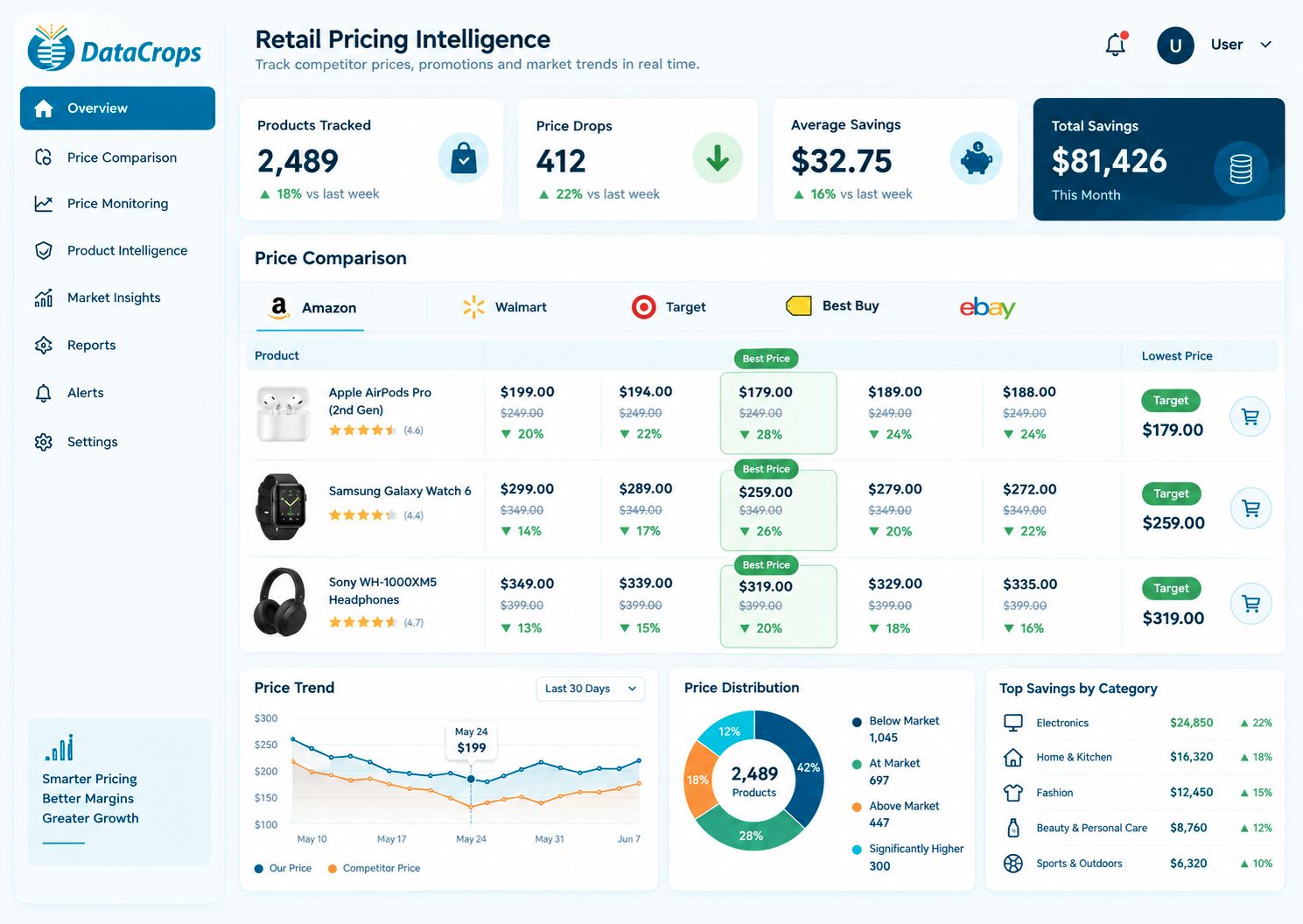
Monitor competitor prices, promotions, products, and pricing trends from one easy to use dashboard.
Advanced Web Data Extraction
Collect pricing and product data from retailers, marketplaces, D2C stores, and other online sources.
Real-Time Price Monitoring
Track price changes, discounts, promotions, and stock availability with timely data updates.
Competitive Pricing Analytics
Compare competitor prices, identify pricing gaps, and analyze market trends with actionable reports.
Flexible Data Delivery
Access pricing intelligence through APIs, email reports, cloud platforms, or automated data exports.
Multi-Format Data Support
Receive structured pricing and product data in Excel, CSV, JSON, XML, or your preferred format.
CAPTCHA & Access Handling
Collect data from websites with common access restrictions and CAPTCHA challenges for more reliable monitoring.
Smart Price Change Alerts
Get automated alerts when competitors change prices, or update product availability.
Turn Your Pricing Data Into Competitive Intelligence
Get a retail pricing intelligence solution tailored to your products, competitors, markets, and monitoring requirements.
Pricing Analytics
Pricing Analytics in Retail: Go Beyond Price Intelligence
Retail pricing analytics helps answer questions that simple price monitoring cannot.
Your team can ask:
How much did the price change?
Which competitors changed their prices?
Which categories are experiencing the most movement?
Where are our prices significantly higher or lower?
Which products have persistent pricing gaps?
Are competitors discounting more aggressively?
How has pricing changed over time?
Which channels show the strongest competitive pressure?
Retail Pricing Teams
Built for Modern Retail Pricing Teams
Online Retailers
Monitor competitor pricing across ecommerce websites and marketplaces to maintain competitive positioning without relying on manual research.
Marketplaces
Track seller pricing, product availability, promotions, and competitive movements across marketplace environments.
D2C Brands
Understand how retailers, resellers, and marketplaces are pricing your products and identify potential pricing or channel issues.
Manufacturers & Brands
Gain visibility into downstream retail pricing and identify pricing inconsistencies across sellers and channels.
Pricing & Revenue Teams
Bring competitor pricing data into pricing analysis and commercial decision making workflows.
Merchandising Teams
Combine pricing information with product and assortment intelligence to understand category positioning.
Use Cases
Use Cases For Retail Pricing Intelligence
Competitor Price Analysis
Compare your pricing against relevant competitors and identify meaningful price gaps.
Price Positioning
Understand whether products are positioned above, below, or close to market benchmarks.
Promotion Monitoring
Track competitor discounts and promotional activity across digital channels.
Assortment & Pricing Analysis
Combine product availability and pricing data to understand competitive assortment.
Marketplace Monitoring
Track pricing movements across major marketplaces and seller environments.
Regional Price Analysis
Compare pricing across markets, regions, or channels where applicable.
Pricing Strategy
Use market intelligence to support pricing decisions based on observed competitive conditions.
Channel Monitoring
Monitor pricing consistency and identify potential pricing violations or unexpected reseller behavior.
DataCrops also offers channel intelligence capabilities focused on reseller pricing, MAP monitoring, product monitoring, and pricing violations, making this a natural adjacent solution for brands with channel management requirements.
Manual v/s Automated
Manual vs Online Retail Pricing Intelligence
| Manual | Online Retail Pricing Intelligence |
|---|---|
| Repeated spreadsheet work | Automated data collection |
| Periodic competitor checks | Scheduled or frequent monitoring |
| Difficult to scale | Designed for scalable data collection |
| Higher risk of inconsistent data | Structured and normalized data |
| Limited historical visibility | Historical pricing analysis |
| Separate data sources | Centralized pricing intelligence |
| Reactive decision making | Faster market response |
| Time spent collecting data | More time available for analysis |
Why DataCrops
Why Choose DataCrops for Retail Pricing Intelligence?
Built Around Web Data
Retail pricing information exists across thousands of websites and digital channels. DataCrops' core platform is built around automated web data extraction and structured data delivery.
Designed for Competitive Markets
DataCrops supports pricing, product, channel, and market intelligence use cases, allowing retailers and brands to connect pricing information with broader competitive context.
Scalable Data Collection
Build pricing intelligence workflows around your specific markets, products, competitors, channels, and monitoring requirements.
Flexible Integration
Use structured data through supported delivery formats and APIs to connect pricing intelligence with existing business systems.
Beyond Basic Price Monitoring
Go from collecting prices to understanding competitive positioning, pricing trends, promotions, and market movements.
Enterprise Oriented Approach
DataCrops positions its broader data extraction platform for scalable business use, with automated extraction, transformation, integration, and analytics capabilities.
How It Works
How DataCrops Retail Pricing Intelligence Works
-
Select Your Sources
Define the retailers, competitors, marketplaces, products, categories, or channels you want to monitor.
-
Collect Pricing Data
DataCrops automatically extracts relevant information from selected online sources.
-
Match & Structure Products
Organize product and pricing information so comparable products can be analyzed consistently.
-
Monitor Market Changes
Track price movements, promotions, availability, and other relevant competitive signals.
-
Analyze & Act
Access structured data, reports, dashboards, or integrations that help your teams make informed pricing decisions.
Retail Strategy
Connect Pricing Intelligence With Your Broader Retail Strategy
Pricing does not exist in isolation.
A competitor's lower price may be connected to a promotion, excess inventory, a different product variant, or a broader assortment strategy.
That is why DataCrops can connect pricing intelligence with related areas such as:
Pricing Intelligence
Product Intelligence
Channel Intelligence
Market Intelligence
This broader perspective helps retailers understand not just what competitors are charging, but also what is happening around those prices.
Data Delivery
Retail Pricing Data That Fits Your Workflow
DataCrops can support structured data delivery for teams that want to:
- Feed pricing data into BI systems
- Build internal pricing dashboards
- Analyze historical pricing
- Create competitive pricing reports
- Support pricing models
- Monitor competitor movements
- Integrate data into internal applications
- Combine pricing data with product or market datasets
Deliver usable retail pricing data in a format your business can actually work with.
Need Retail Pricing Data for Your Systems?
Get structured competitor pricing and product data delivered through APIs, files, or workflows that fit your existing technology stack.
FAQs
People also search for Retail Pricing Intelligence
What is retail pricing intelligence?
Retail pricing intelligence is the process of collecting and analyzing competitor prices, promotions, product availability, and market pricing trends to help retailers make informed pricing decisions.
Why is retail pricing intelligence important?
Retail pricing intelligence helps businesses understand competitive pricing, identify pricing gaps, monitor market changes, and make pricing decisions using current market data rather than manual research or outdated information.
What data is included in retail pricing intelligence?
Retail pricing data can include competitor prices, discounts, promotions, product availability, seller information, historical prices, product attributes, and other competitive market signals.
What is the difference between retail price intelligence and price monitoring?
Price monitoring primarily focuses on tracking price changes. Retail price intelligence goes further by analyzing those changes alongside competitors, products, promotions, market trends, and other context to support business decisions.
How does pricing intelligence work for retailers?
A retail pricing intelligence platform automatically collects pricing and product information from relevant online sources, structures and matches the data, monitors changes, and provides analytics or reports that retailers can use for pricing decisions.
How can pricing intelligence improve retail profitability?
Pricing intelligence can help retailers identify pricing gaps, avoid unnecessary discounting, respond to competitive changes, protect margins, and identify opportunities to improve price positioning.
How often should competitors retail pricing data be collected?
The appropriate frequency depends on the market. Highly competitive ecommerce categories may require multiple updates per day, while slower moving categories may be adequately served by daily or weekly monitoring.
What is retail pricing analytics?
Retail pricing analytics is the analysis of pricing data to identify competitive trends, price gaps, historical movements, promotional patterns, and other insights that support retail pricing decisions.
Can DataCrops monitor competitor prices?
Yes. DataCrops provides competitor price monitoring and retail pricing intelligence capabilities designed to collect and analyze pricing information across online retail and marketplace sources.
Can retail pricing intelligence track marketplaces?
Yes. Retail pricing intelligence can be used to monitor product prices, sellers, promotions, availability, and competitive movements across marketplace environments. DataCrops specifically positions its pricing and product intelligence solutions for marketplace use cases.
Can pricing intelligence support D2C brands?
Yes. D2C brands can use pricing intelligence to monitor retailer and marketplace pricing, understand competitive positioning, track promotions, and identify potential channel pricing issues.
Can retail pricing data be integrated with other systems?
Yes. DataCrops supports flexible data delivery and integration options, including API based workflows and structured formats, depending on the use case.
Ready to Turn Retail Pricing Data Into Competitive Advantage?
Get a clearer view of competitor pricing, promotions, product availability, and market movements with DataCrops Retail Pricing Intelligence.