Quick Answer
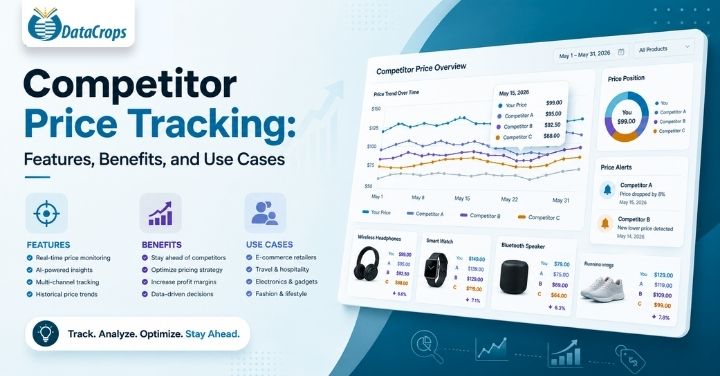
Competitor price tracking is the continuous process of monitoring competitors' product prices across ecommerce websites, marketplaces, apps, and online stores using automated software, AI, APIs, and web scraping technology. In 2026, businesses rely on AI powered competitor price tracking tools to collect the latest pricing intelligence, optimize dynamic pricing, increase profit margins, and respond faster to market changes.
Quick Facts.
|
Topic |
Summary |
|
Primary Purpose |
Monitor competitor pricing automatically |
|
Core Technologies |
AI, web scraping, APIs, automation |
|
Main Benefits |
Better pricing, higher margins, faster decisions |
|
Best For |
Ecommerce, retail, marketplaces, travel, SaaS |
|
Data Sources |
Websites, marketplaces, mobile apps, APIs |
|
Update Frequency |
Latest, hourly, daily, or custom schedules |
|
Key Outputs |
Price alerts, historical trends, dashboards, recommendations |
Key Takeaways
- AI has transformed competitor price tracking from manual monitoring to real time automation.
- Web scraping and APIs provide accurate pricing intelligence at scale.
- Retailers using automated price monitoring often improve pricing response times dramatically compared with manual workflows.
- Dynamic pricing depends on continuous competitor pricing data.
- Modern ecommerce brands monitor marketplaces, retailer websites, promotions, stock availability, ratings, and shipping costs, not just product prices.
- Choosing the right competitor price tracking software depends on scalability, data quality, update frequency, and integration capabilities.
Introduction
Competitor Price Tracking has become one of the most important competitive intelligence practices in ecommerce and retail.
Today's online shoppers compare prices across multiple websites before making purchasing decisions. A small price difference can influence conversions, customer loyalty, and revenue.
This is why businesses increasingly use competitor price trackers, AI powered pricing intelligence platforms, and automated web scraping solutions to monitor competitors 24/7.
Instead of checking thousands of products manually, companies now receive live pricing updates, pricing alerts, historical trends, and actionable recommendations within minutes.
Whether you operate an ecommerce store, marketplace, retail chain, SaaS pricing platform, or brand manufacturing business, competitor pricing intelligence has become essential for sustainable growth.
What Is Competitor Price Tracking?
Competitor Price Tracking is the automated process of collecting, monitoring, analyzing, and comparing product prices from competitors across digital sales channels.
The process includes monitoring:
- Product prices
- Discount campaigns
- Flash sales
- Coupons
- Shipping charges
- Stock availability
- Marketplace pricing
- Regional pricing
- Bundle offers
- Seller rankings
The collected information helps businesses make informed pricing decisions instead of relying on assumptions.
Simple Definition
Competitor price tracking is the continuous monitoring of competitor pricing data to improve pricing strategy, maximize profitability, and remain competitive.
How Competitor Price Tracking Works
Modern competitor price tracking platforms combine several technologies.
Step 1: Collect Pricing Data from Competitor Websites
The first step in competitor price tracking is identifying the competitors, marketplaces, and online stores that matter most to your business. The platform continuously monitors these sources to capture important market information, including:
- Product prices
- Discounts and promotional offers
- Product availability
- Shipping charges
- New product launches
Because the data is collected automatically, businesses can monitor thousands or even millions of products without manual effort.
Step 2: Gather Data Using Web Scraping and APIs
Modern competitor price tracking platforms use intelligent web scraping technology and official APIs to collect fresh pricing data at scheduled intervals or in real time.
Automated data collection ensures businesses always have the latest market information while eliminating time consuming manual price checks. This allows pricing teams to react quickly when competitors adjust their pricing strategies.
Step 3: Validate and Clean Data with AI
Raw pricing data is valuable only when it is accurate. AI powered validation improves data quality by:
- Matching identical products across multiple websites
- Removing duplicate listings
- Identifying incorrect or outdated prices
- Standardizing product attributes such as size, brand, and SKU
This process delivers reliable competitor pricing intelligence that businesses can confidently use for decision making.
Step 4: Analyze Data in a Price Intelligence Dashboard
Once validated, the pricing data is displayed in a centralized dashboard where teams can easily monitor market activity.
A modern price intelligence dashboard typically includes:
- Real time competitor price comparisons
- Historical pricing trends
- Promotion and discount tracking
- Price change history
- Competitor benchmarking
- Product performance insights
Having all pricing intelligence in one place enables faster analysis and more informed business decisions.
Step 5: Receive Real Time Alerts and Automate Pricing
Instead of constantly monitoring the market manually, businesses receive automated notifications whenever competitors:
- Change product prices
- Launch new promotions
- Offer limited time discounts
- Restock or run out of inventory
Many competitor price tracking solutions also support dynamic pricing, allowing businesses to automatically adjust their own prices based on predefined pricing rules and competitive market conditions.
Step 6: Make Smarter Pricing Decisions
The final goal of competitor price tracking is to transform market data into profitable business decisions.
With accurate, real time pricing intelligence, businesses can:
- Stay competitive in fast changing markets
- Protect profit margins
- Increase conversion rates
- Respond quickly to competitor price changes
- Optimize promotional campaigns
- Build more effective pricing strategies
Rather than relying on guesswork, decision makers use verified pricing data to create pricing strategies that drive sustainable growth.
Typical Workflow
- Identify competitors
- Match identical products
- Extract pricing information
- Clean and validate data
- Detect pricing changes
- Generate alerts
- Recommend pricing actions
- Integrate with ecommerce systems
Why Competitor Price Tracking Matters in 2026
Online competition has intensified across nearly every industry.
Consumers now compare products instantly using:
- Google Shopping
- Amazon
- Walmart
- Shopify stores
- Price comparison websites
- Mobile apps
- AI shopping assistants
Without automated monitoring, businesses risk:
- Losing customers
- Pricing products too high
- Pricing products too low
- Reduced margins
- Lower conversion rates
Competitor monitoring minimizes these risks.
Benefits of Competitor Price Tracking
1. Better Pricing Decisions
Real time competitor insights eliminate guesswork.
Instead of relying on outdated spreadsheets, pricing teams receive live market intelligence.
2. Increased Profit Margins
Businesses identify opportunities to:
- Increase prices safely
- Protect margins
- Avoid unnecessary discounting
3. Dynamic Pricing
AI automatically recommends optimal pricing based on:
- Competitor prices
- Inventory
- Demand
- Seasonality
- Customer behavior
4. Faster Market Response
Receive instant alerts whenever competitors change prices.
5. Improved Customer Retention
Competitive pricing increases trust and reduces customer churn.
6. Smarter Promotional Planning
Monitor:
- Black Friday
- Prime Day
- Holiday campaigns
- Weekend discounts
- Coupon strategies
7. Better Product Positioning
Understand whether your products are:
- Premium
- Competitive
- Budget
- Underpriced
Best Competitor Price Tracking Methods
|
Method |
Accuracy |
Speed |
Scalability |
Best For |
|
Manual Research |
Low |
Slow |
Poor |
Small businesses |
|
Spreadsheet Tracking |
Medium |
Slow |
Low |
Limited catalogs |
|
Browser Extensions |
Medium |
Medium |
Medium |
Individual sellers |
|
APIs |
High |
Very High |
Excellent |
Enterprise retailers |
|
Web Scraping |
Very High |
High |
Excellent |
Ecommerce intelligence |
|
AI Price Monitoring Platforms |
Highest |
Real Time |
Enterprise |
Large scale businesses |
AI Powered Competitor Price Tracking
Artificial intelligence has significantly improved pricing intelligence.
Modern AI systems can automatically:
- Match identical SKUs
- Detect hidden discounts
- Predict pricing trends
- Recommend price adjustments
- Forecast competitor behavior
- Identify pricing anomalies
- Estimate demand elasticity
Instead of simply showing competitor prices, AI explains why prices changed and what businesses should do next.
Best Key Features of Competitor Price Tracking Software
An ideal competitor price tracking tool should provide:
- Latest price updates
- AI powered analytics
- Historical pricing charts
- Product matching
- Marketplace monitoring
- API integration
- Web scraping capabilities
- Dynamic pricing recommendations
- Automated alerts
- Custom dashboards
- Exportable reports
- Multi country support
Examples
Ecommerce Retailer
- Tracks competitor prices every hour.
Result:
- Faster price updates
- Improved conversion rates
- Better promotional timing
Consumer Electronics Brand
- Monitors thousands of SKUs across multiple retailers.
- Uses AI recommendations to adjust pricing daily.
Travel Industry
- Hotels monitor competitor room rates continuously.
- Dynamic pricing engines automatically adjust prices based on market demand.
Grocery Retail
Tracks promotional pricing across regional competitors to maintain price competitiveness.
Competitor Price Tracking Statistics (2026)
Note: These figures represent widely reported industry trends and aggregated market observations. Results vary by industry, product category, and pricing strategy.
- More than 80% of online shoppers compare prices before purchasing.
- Large ecommerce retailers often monitor competitor prices multiple times per day, with some updating hourly or more frequently.
- Dynamic pricing adoption continues to expand across retail, travel, and hospitality.
- AI powered pricing platforms are increasingly replacing manual spreadsheet based competitor monitoring.
- Retailers using automated pricing intelligence generally react to market changes much faster than those relying on manual processes.
Comparison: Manual vs AI Competitor Price Tracking
|
Feature |
Manual |
AI Powered |
|
Accuracy |
Medium |
High |
|
Automation |
No |
Yes |
|
Latest Updates |
No |
Yes |
|
Product Matching |
Manual |
AI |
|
Alerts |
No |
Yes |
|
Historical Analysis |
Limited |
Advanced |
|
Scalability |
Low |
Enterprise |
|
ROI |
Moderate |
High |
Common Challenges
Businesses often struggle with:
- CAPTCHA protection
- Website layout changes
- Large product catalogs
- SKU matching
- Regional pricing
- Marketplace complexity
- Data quality
- Rate limits
Professional web scraping infrastructure and AI validation help overcome these challenges.
Future Trends for Competitor Price Tracking
The future of pricing intelligence is increasingly autonomous.
1. AI Pricing Agents
AI systems will continuously monitor markets and recommend pricing strategies without manual intervention.
2. Predictive Pricing
Businesses will forecast competitor price movements before they occur.
3. Generative AI Insights
Instead of dashboards alone, AI assistants will summarize pricing changes in plain language and suggest actions.
4. Hyper Personalized Pricing
Pricing engines will tailor offers based on customer behavior, location, and demand while respecting legal and ethical considerations.
5. Unified Market Intelligence
Pricing, inventory, reviews, promotions, and demand signals will be combined into a single decision platform.
Best Competitor Price Tracking Software Evaluation Criteria
When comparing solutions, consider:
|
Criteria |
Why It Matters |
|
Data Accuracy |
Reduces pricing errors |
|
Update Frequency |
Enables faster reactions |
|
AI Insights |
Supports smarter decisions |
|
API Support |
Simplifies integration |
|
Dashboard Quality |
Improves usability |
|
Global Coverage |
Supports international expansion |
|
Historical Data |
Enables trend analysis |
|
Scalability |
Handles growing product catalogs |
|
Customer Support |
Speeds implementation |
|
Security & Compliance |
Protects business data |
Conclusion
Competitor Price Tracking has evolved from a manual task into a strategic capability powered by AI, automation, web scraping, and latest data intelligence. As ecommerce competition intensifies in 2026, businesses that can track competitor prices, analyze market movements, and respond quickly are better equipped to protect margins, improve customer value, and adapt to changing conditions.
Whether you're evaluating a competitor price tracker, comparing competitor price tracking tools, or implementing best competitor price tracking software, success depends on reliable data, actionable insights, and a pricing strategy aligned with your business goals. By combining AI driven analytics with human expertise, organizations can make faster, more confident pricing decisions and build a sustainable competitive advantage.
FAQs of Competitor Price Tracking
What is competitor price tracking?
Competitor price tracking is the process of automatically monitoring competitor product prices, promotions, inventory status, and related market signals to support better pricing decisions and maintain competitiveness.
How do businesses track competitor prices?
Businesses use web scraping, APIs, AI powered monitoring platforms, browser automation, and pricing intelligence software to collect and analyze competitor pricing data at scale.
What is the best competitor price tracking software?
The best solution depends on your business size and needs. Look for platforms that offer the latest updates, AI analytics, historical pricing, API integration, product matching, alerts, and scalable infrastructure.
Why is AI important for competitor price tracking?
AI improves product matching, identifies pricing patterns, predicts trends, reduces manual effort, and provides actionable recommendations based on the latest market intelligence.
How often should competitor prices be monitored?
For fast moving ecommerce categories, hourly or near latest monitoring is common. For slower moving industries, daily or weekly tracking may be sufficient depending on pricing volatility.
Is competitor price tracking legal?
Yes. Monitoring publicly available pricing information is generally legal, provided businesses comply with applicable laws, website terms where relevant, intellectual property rights, and data privacy regulations.
Can small businesses benefit from competitor price tracking?
Absolutely. Even smaller retailers can use automated tools to avoid manual monitoring, respond more quickly to price changes, and make more informed pricing decisions.
What industries benefit most from competitor price tracking?
Industries that commonly benefit include ecommerce, retail, consumer electronics, hospitality, travel, grocery, automotive, pharmaceuticals, fashion, and manufacturing.