Introduction
Pricing has become one of the most critical competitive factors in modern business.
Whether you're running an ecommerce store, SaaS platform, airline, logistics company, or retail operation, pricing decisions directly impact revenue, profitability, customer acquisition, and market share.
Historically, businesses tracked competitor prices manually using spreadsheets and periodic market research. However, as digital marketplaces expanded and prices began changing multiple times per day, manual processes became increasingly ineffective.
This shift has accelerated the adoption of the automated pricing tool, enabling businesses to monitor competitors continuously and make data driven pricing decisions.
The question is:
Should businesses still rely on manual price monitoring, or is automation the smarter choice for growth in 2026?
Let's explore.
Quick Answer
For most businesses in 2026, an automated pricing tool is significantly more effective than manual price monitoring.
Automated solutions collect competitor pricing data in real time, identify market trends, eliminate human errors, and enable faster pricing decisions. While manual monitoring may still work for very small businesses with limited products, automation delivers better scalability, efficiency, and profitability.
Bottom Line: Businesses that rely on automated price intelligence can respond faster to market changes and gain a competitive advantage.
Key Takeaways
- Automated price monitoring is faster and more accurate than manual tracking.
- Latest competitor pricing data improves pricing decisions.
- AI powered automated pricing tools reduce human effort and operational costs.
- Ecommerce, retail, SaaS, logistics, and travel companies benefit significantly from automation.
- Manual monitoring becomes inefficient as product catalogs and competitors grow.
- Businesses using pricing automation often experience higher profit margins and improved revenue performance.
What Is an Automated Pricing Tool?
An automated pricing tool is software that continuously collects, analyzes, and reports pricing data from competitors, marketplaces, suppliers, and online retailers.
These tools leverage:
- Web scraping
- AI algorithms
- Machine learning
- Competitive intelligence
- Market analytics
to provide actionable pricing insights.
Unlike manual monitoring, automated solutions operate 24/7 and process thousands of products simultaneously.
How Automated Pricing Software Works
Step 1: Data Collection
The system extracts pricing information from:
- Ecommerce websites
- Online marketplaces
- Retail portals
- Competitor websites
- Supplier catalogs
Step 2: Data Cleaning
Collected information is standardized and validated to ensure accuracy.
Step 3: Competitor Matching
Products are matched against competitor listings.
Step 4: Analytics
The platform analyzes:
- Price changes
- Promotions
- Discounts
- Inventory fluctuations
- Market trends
Step 5: Recommendations
AI generates pricing recommendations to maximize revenue and competitiveness.
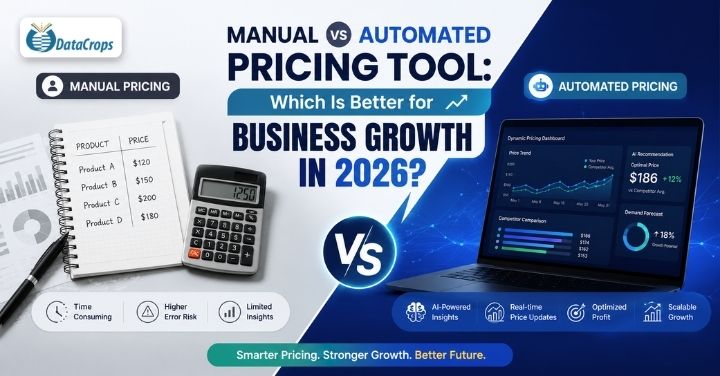
Manual vs Automated Pricing Tool
|
Factor |
Manual Monitoring |
Automated Monitoring |
|
Speed |
Slow |
Real Time |
|
Accuracy |
Moderate |
High |
|
Scalability |
Limited |
Unlimited |
|
Cost Efficiency |
Low |
High |
|
Human Error |
Common |
Minimal |
|
Reporting |
Manual |
Automated |
|
Market Coverage |
Limited |
Extensive |
|
Competitor Tracking |
Few Competitors |
Hundreds of Competitors |
|
Updates |
Periodic |
Continuous |
|
Business Growth Support |
Limited |
Strong |
Winner: Automated Monitoring
For growing businesses, automation delivers substantially better outcomes.
Benefits of Using an Automated Pricing Tool
1. Market Intelligence
- Competitor prices can change multiple times daily.
- Automation ensures you never miss important pricing shifts.
2. Faster Decision Making
Instead of waiting days for manual reports, decision makers receive instant insights.
3. Improved Profit Margins
Businesses can avoid unnecessary discounting while remaining competitive.
4. Enhanced Customer Retention
Competitive pricing improves customer satisfaction and loyalty.
5. Operational Efficiency
Teams spend less time collecting data and more time implementing strategy.
6. Better Competitive Intelligence
Businesses gain visibility into:
- Competitor promotions
- Pricing trends
- Product launches
- Market positioning
Quick Facts
Definition
An automated pricing tool continuously tracks and analyzes competitor prices to improve pricing decisions.
Best For
- Ecommerce businesses
- Retail chains
- Marketplaces
- SaaS companies
- Logistics providers
Main Benefit
Real time pricing intelligence.
Key Technology
- Web Scraping
- Artificial Intelligence
- Machine Learning
- Competitive Intelligence
Business Impact
Higher revenue, improved margins, and faster market responsiveness.
Price Monitoring Statistics for 2026
Industry research shows:
- Over 80% of online shoppers compare prices before purchasing.
- Dynamic pricing adoption continues to grow across retail and ecommerce sectors.
- AI driven pricing solutions can reduce manual pricing effort by more than 70%.
- Businesses using automated pricing systems often respond to market changes significantly faster than manual teams.
These trends demonstrate why pricing intelligence has become a strategic necessity rather than a competitive luxury.
Conclusion
The debate between manual and automated price monitoring is becoming increasingly one sided.
While manual monitoring may still serve very small operations, businesses aiming for sustainable growth in 2026 should adopt an automated pricing tool to remain competitive.
Automation delivers real time intelligence, reduces operational overhead, improves pricing accuracy, and supports faster decision making.
As ecommerce, retail, logistics, travel, and SaaS markets become more competitive, companies that invest in pricing intelligence and automation will be better positioned to protect margins, increase revenue, and outperform competitors.
If your organization is looking to implement advanced price monitoring, competitor intelligence, web scraping, or automated pricing solutions, DataCrops can help transform raw market data into actionable business intelligence that drives measurable growth.
FAQ of Manual vs Automated Pricing Tool
1. Is an automated pricing tool worth it for small businesses?
Yes. Even small businesses can benefit from improved efficiency, better competitor visibility, and reduced manual effort.
2. What industries benefit most from automated price monitoring?
Industries include:
- Ecommerce
- Retail
- Travel
- Airlines
- SaaS
- Logistics
- Manufacturing
3. Can automated pricing tools replace pricing managers?
No. They enhance decision making but strategic oversight still requires human expertise.
4. How often should competitor prices be monitored?
In highly competitive markets, continuous monitoring is recommended.
5. What is the biggest advantage of automated pricing tools?
Real time visibility into market pricing changes.
6. Are automated pricing tools accurate?
When powered by reliable web scraping and data intelligence systems, accuracy levels can be extremely high.